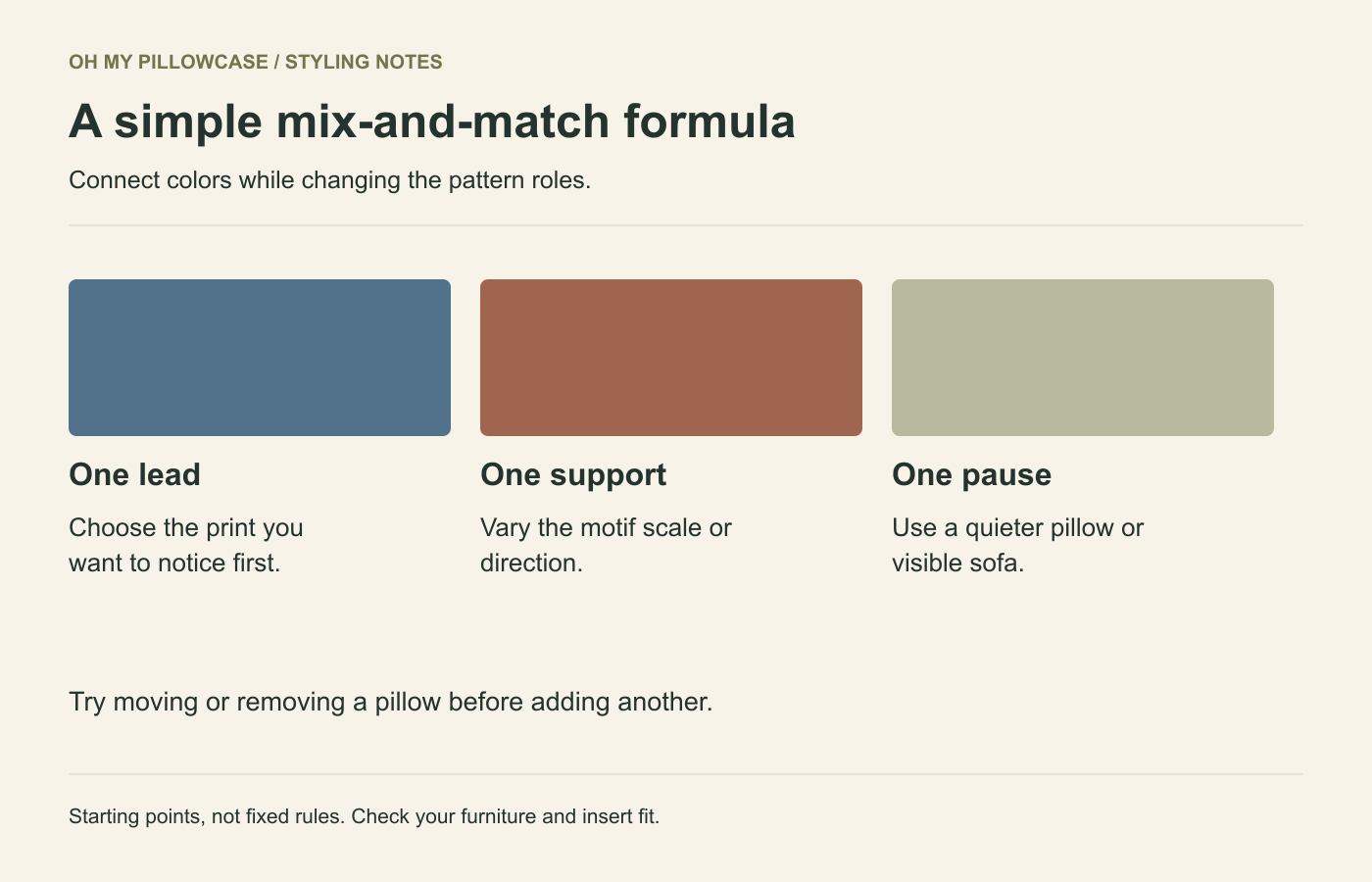
To mix and match pillow covers, connect them through one or two colors while giving their patterns different roles. Choose a leading design, add a supporting print, and leave a quieter area nearby. Start with the furniture and textiles already in the room rather than choosing every pillow in isolation.
Use the room as your starting palette
Look at the sofa, rug, curtains and artwork before choosing a cover. These large or fixed elements already establish the room’s color balance. Pick one shade from them to repeat at sofa height, then decide whether the arrangement needs more light, more depth or a warm accent.
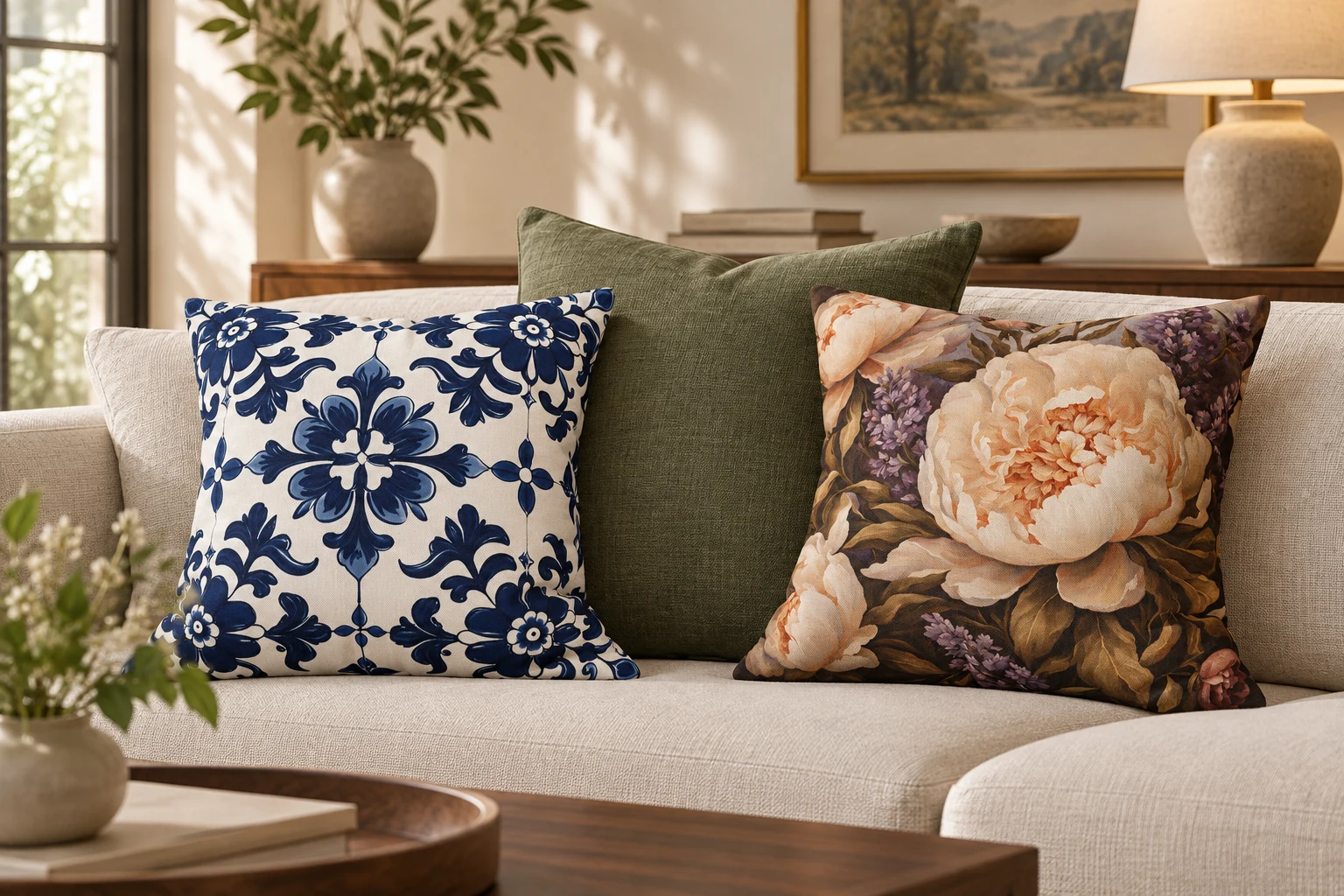
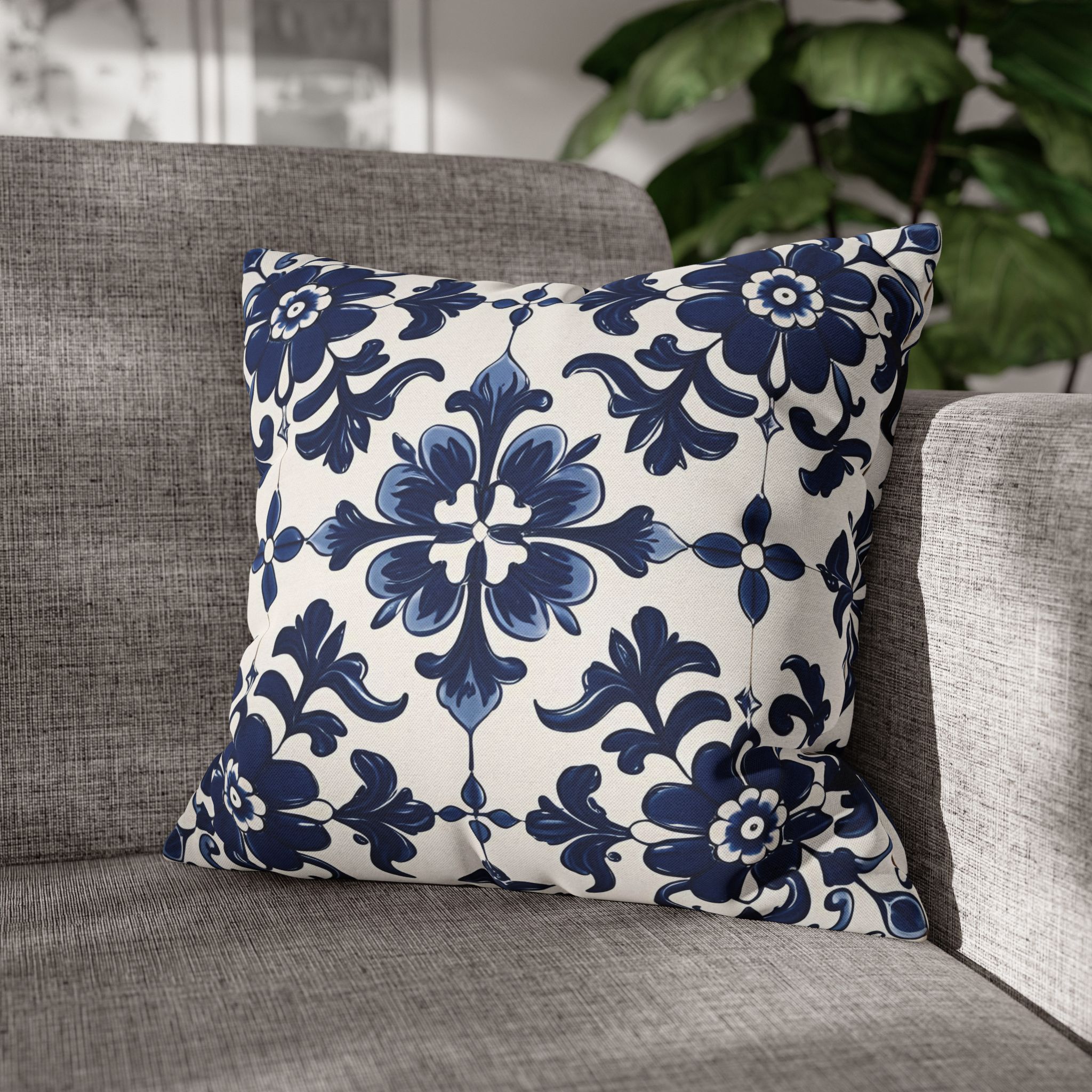
A cream sofa and dark wood table can accommodate several directions, but you do not need all of them. Blue-and-cream tile gives a cooler patterned accent. Rust and olive geometry creates a warmer one. Choose the direction that connects to the rest of the room.
A cobalt tile print can lead when blue appears in nearby art or ceramics. Let its cream background relate to the upholstery, then use a different shape for the next pillow.
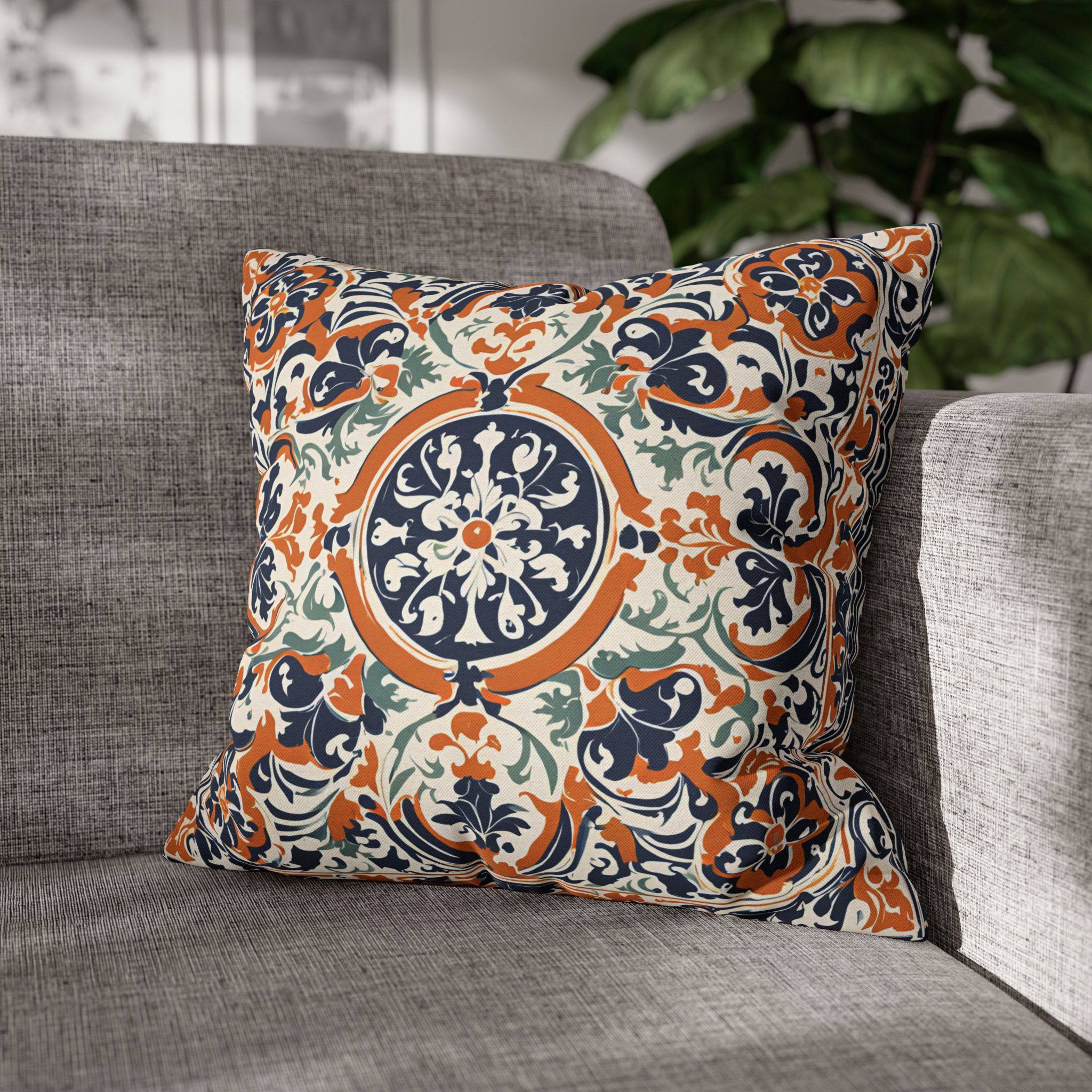
A terracotta tile pattern offers a warmer route. Treat it as an alternative starting point unless the room already supports both blue and terracotta.
Choose one design to lead
Select the print you most want to see from across the room. It might be a large flower, a central medallion or a clear geometric shape. Place it where enough of the artwork will remain visible, then let the other pillows support it.
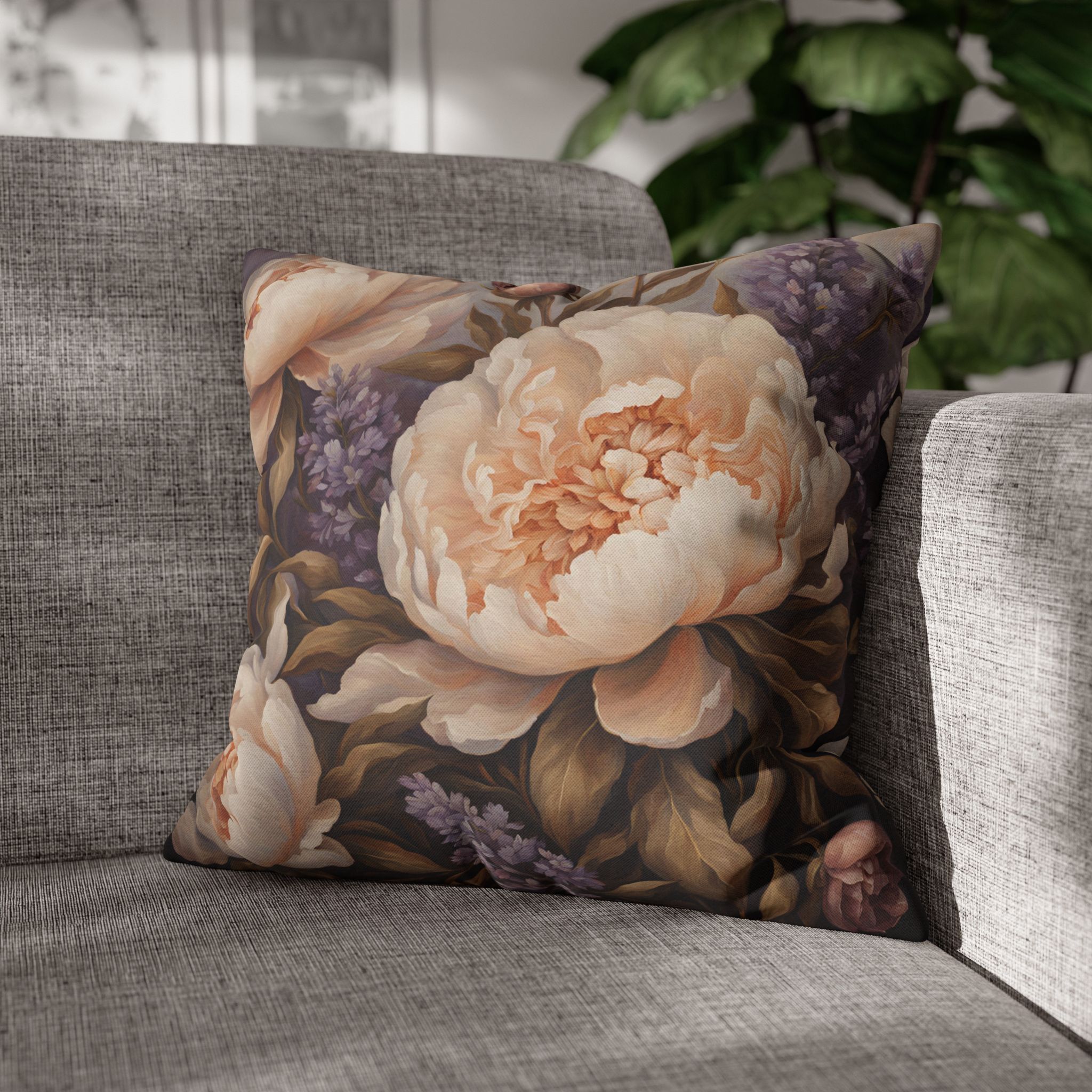
A dark-ground cream peony provides a strong light-and-dark focal point. Pull a cream or muted green detail into the neighboring pillow instead of putting another equally large bloom directly beside it.
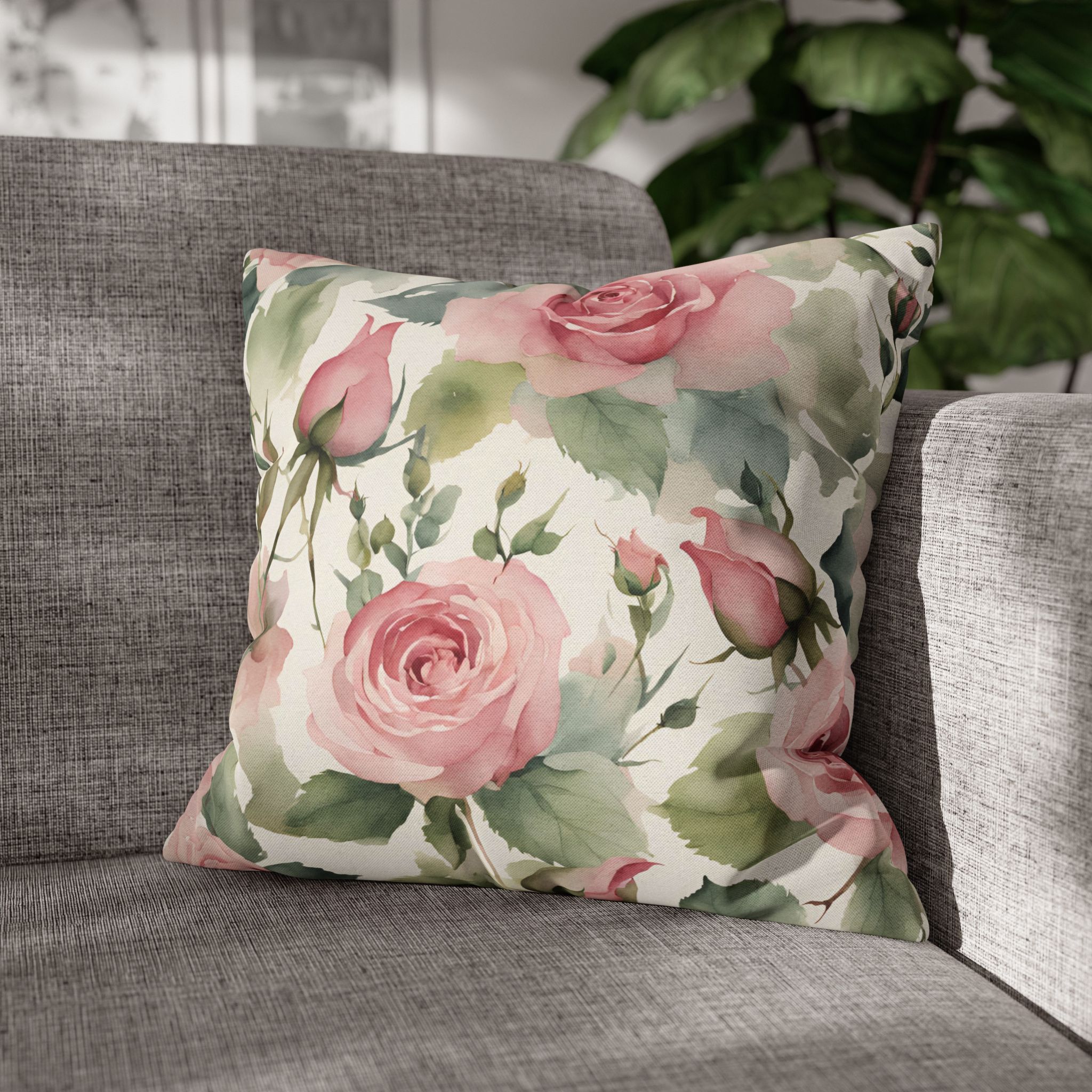
A blush rose design suggests a softer arrangement. Its colors can connect to pale green or warm neutral surroundings, while a nearby geometric print introduces a different kind of edge.
A statement pillow does not have to be the largest. A highly contrasting 18-inch print may attract more attention than a quieter 20-inch design. Judge the visual weight as well as the dimensions.
This is also why buying several favorites individually can be difficult. Each may have been chosen to stand out, leaving no cover willing to play the supporting role. Choose the lead first, then ask what the arrangement still needs.
Vary pattern scale and shape
Compare the size of the motifs, not just the size of the pillows. A small repeat and a large flower can sit together more clearly than two dense prints with similar detail. A banded design changes the direction of the eye beside a central medallion.
Cream, charcoal and madder bands can support a warmer focal print. The lines supply structure while their colors give you several connections to choose from.
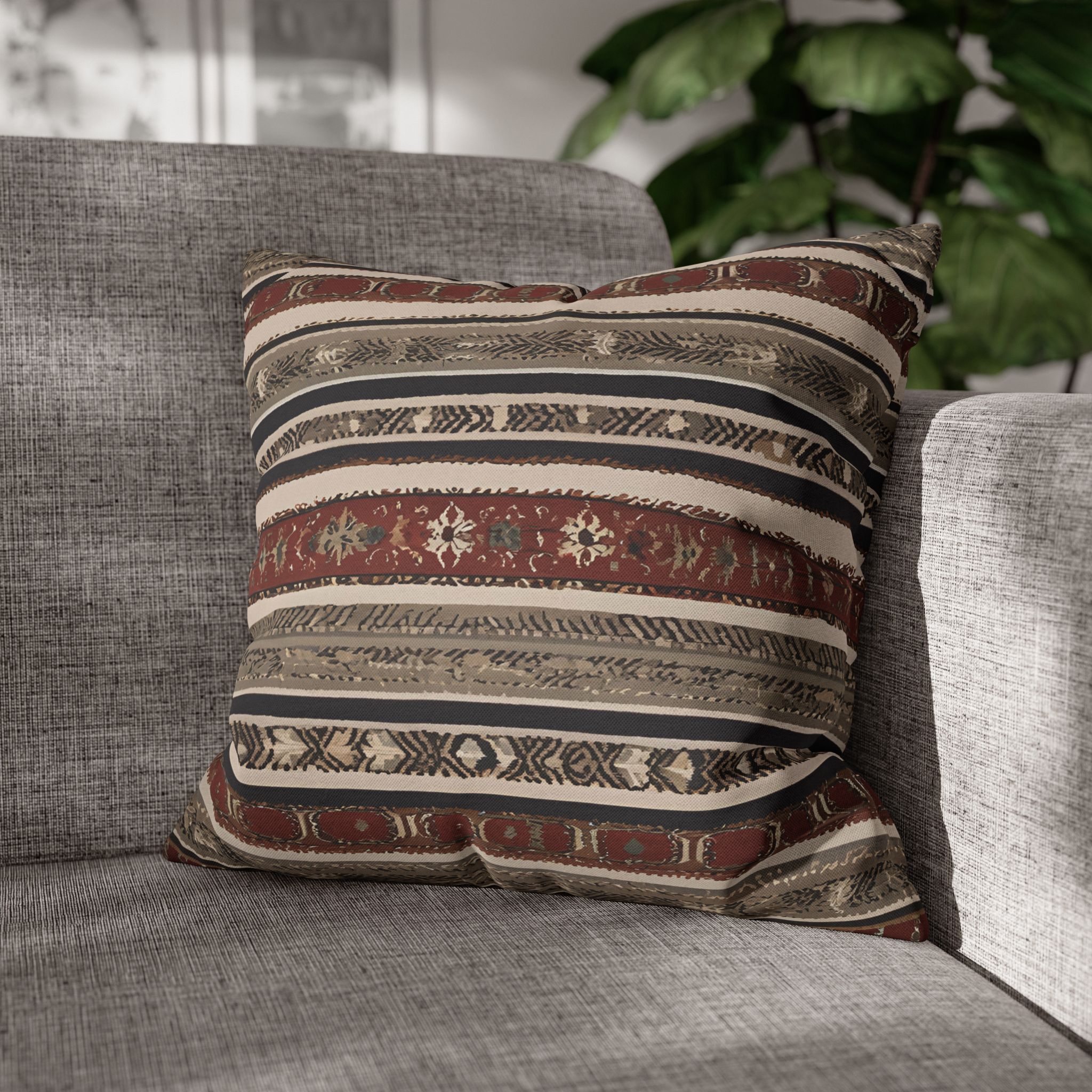
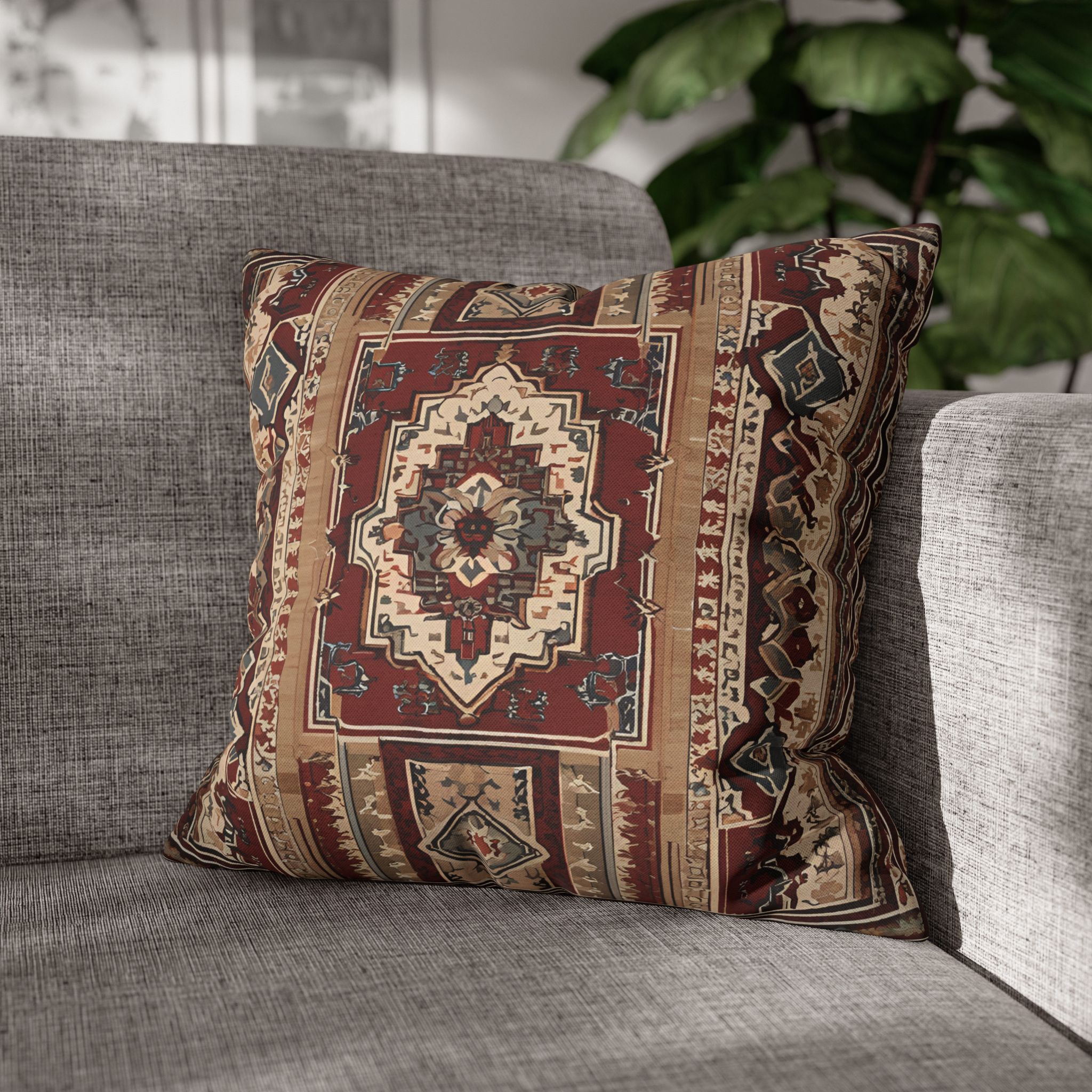
A red medallion supplies the contrasting central shape. Give it room to read rather than hiding the middle behind another pillow. If your rug already has a similar medallion, consider whether repeating it strengthens the room or makes the pattern too insistent.
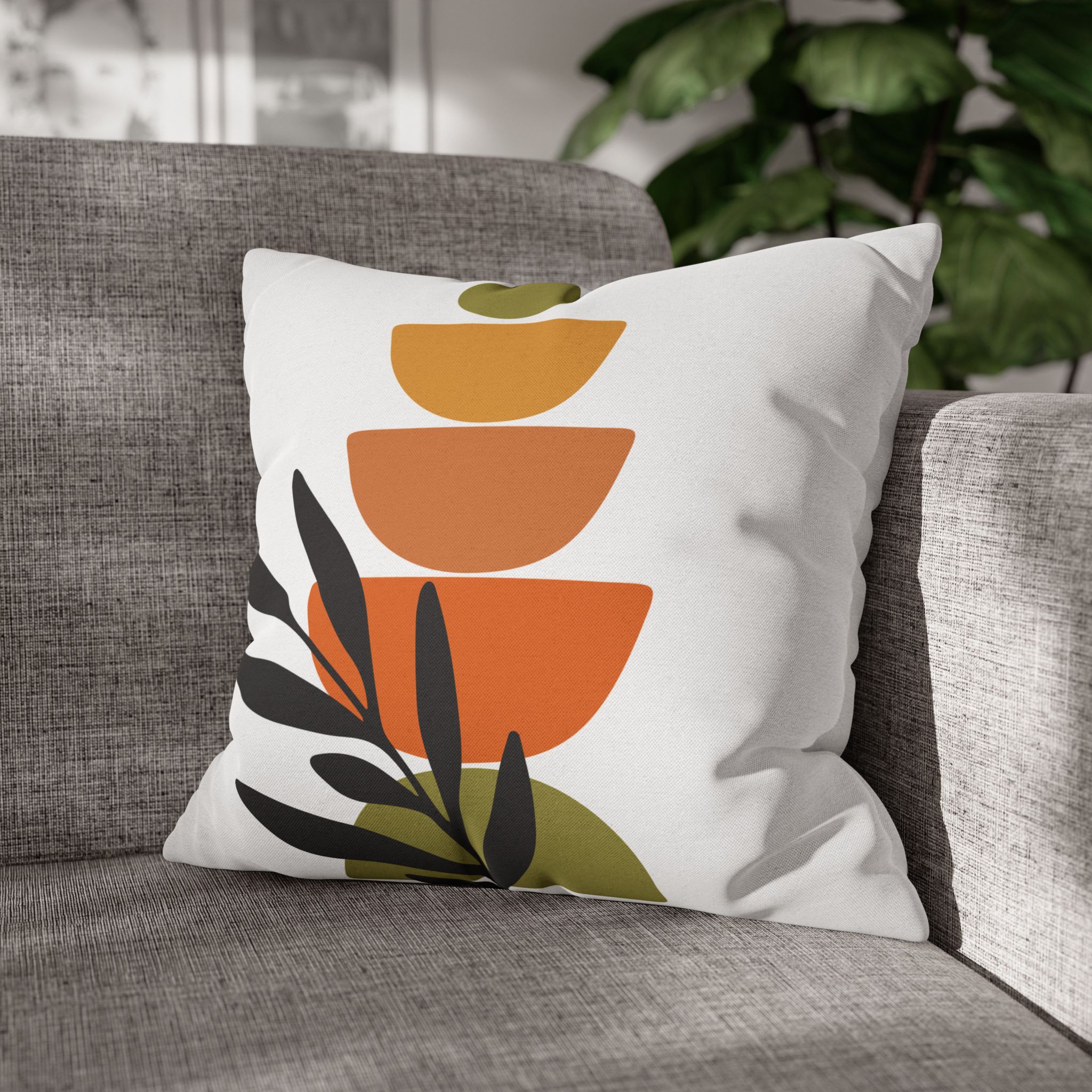
For a different pairing, combine broad geometry with a watercolor subject. They need a shared color, but their edges and motif sizes can differ. The contrast helps the arrangement feel connected without looking identical.
A terracotta, mustard and olive geometric cover can provide broad shapes beside a more detailed print. Repeat only one of its colors in the partner to avoid making the palette unnecessarily complex.
For more on related repeats, see how to mix stripes and checks. The same principle applies across collections: make the difference in scale easy to see.
Leave a quieter place between strong prints
A quiet area might be a plain pillow you already own, a print with fewer colors or simply uncovered upholstery. It does not need to be an additional purchase. Try spreading two detailed pillows farther apart before deciding you need a third.
A beige, green and rust landscape can provide a broader color structure than an intricate floral. Compare the actual product images, however, rather than assuming every landscape is quiet and every floral is busy.
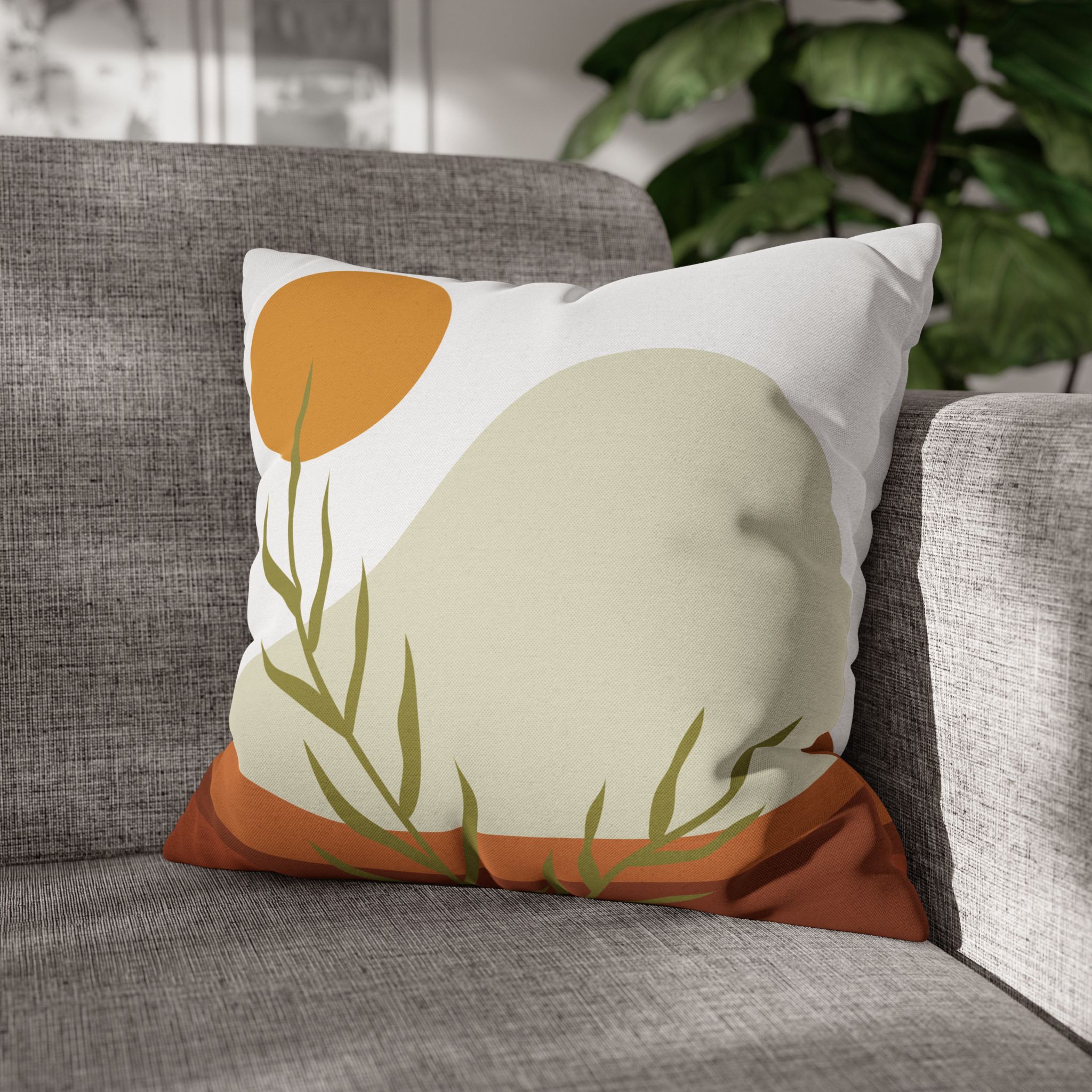
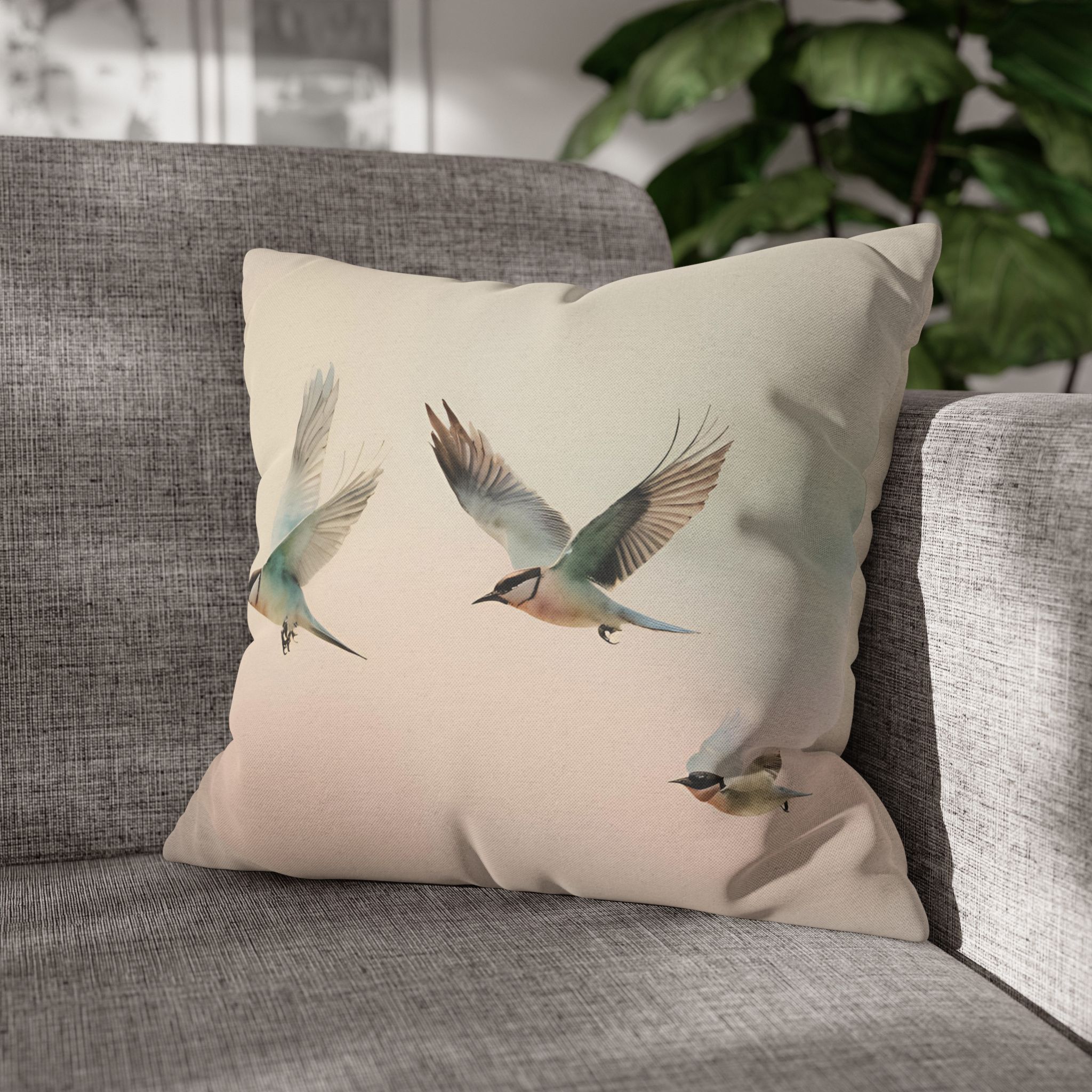
A neutral beige bird study gives another option when the arrangement needs an illustrated subject in a restrained palette. Let its background connect with the sofa or an existing cushion.
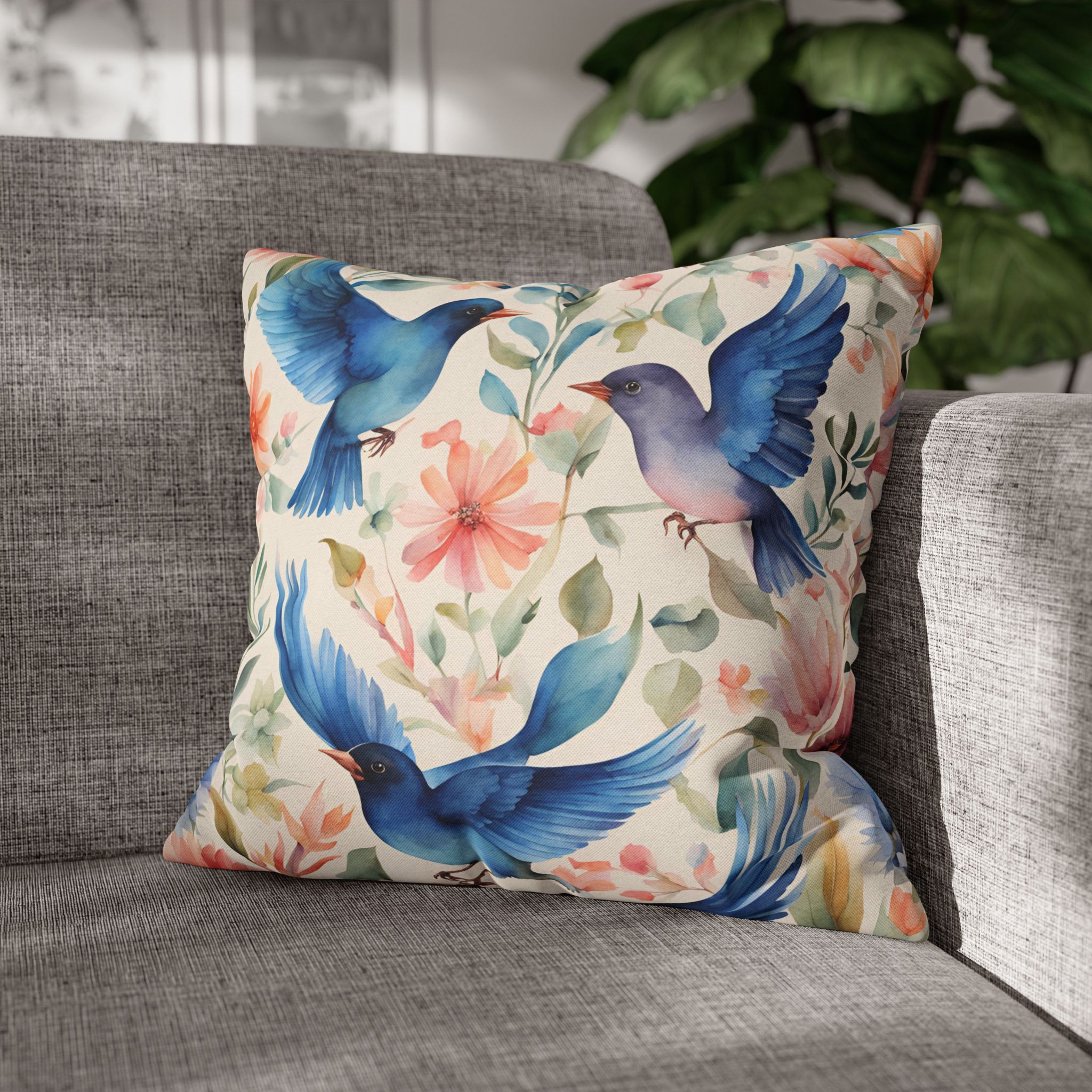
Blue birds with pink flowers provide a more colorful alternative. Use that design where blue or pink already has a purpose in the room, and let it take the leading role if it attracts the most attention.
Arrange sizes for comfort and balance
Place larger pillows toward the back or arms, then bring smaller ones forward. This can create depth, but equal-sized pairs are also useful on symmetrical furniture. There is no rule that every sofa needs an odd number.
| Arrangement | Starting sizes | Visual roles |
|---|---|---|
| Two pillows | Two 18-inch covers | One leading print and one quieter partner |
| Three pillows | Two 20-inch covers and one 18-inch accent | Supporting ends with a clear focal design |
| Deep sectional grouping | One 24-inch anchor and one 20-inch partner | A substantial back layer with visible artwork |
| Small chair | One 14 or 16-inch cover | A single accent with room to sit |
Adjust these examples to the actual furniture. A shallow sofa may need smaller anchors, while a low back can make a tall pillow feel unsupported. Use the size guide to check the cover and insert separately.
Sit down, then take a photograph from the doorway. Look for two busy designs touching, one end that feels much darker, or a main motif hidden by overlap. Try moving or removing a pillow before adding anything.
All Oh My PillowCase covers are 100% polyester with double-sided prints and concealed zippers. The printed designs do not imply linen, embroidery or woven rug construction. Seven square sizes are available from 14 to 28 inches, and inserts are not included.
Frequently asked questions
Do throw pillow covers have to match?
No, they can relate through a repeated color, a similar contrast level or complementary shapes. Matching pairs are also a valid choice when you want symmetry.
How many patterns can I mix on one sofa?
Start with two and add a third only if each has a clear role. The room’s rug and curtains count toward the overall amount of pattern, even though they are not on the sofa.
Can I mix pillows from different collections?
Yes, such as a floral with geometry or a tile repeat with a bird illustration. Connect their colors and make the difference in pattern scale visible.
For a geometric starting point, browse boho pillow covers.